Space weather
When the Sun reaches the telegraph, and the grid
NASA Science tells the Carrington Event as history, names the Hydro-Québec blackout of 1989, and points to NOAA’s Space Weather Prediction Center. This page keeps that official wording, and does not turn it into a scare piece.
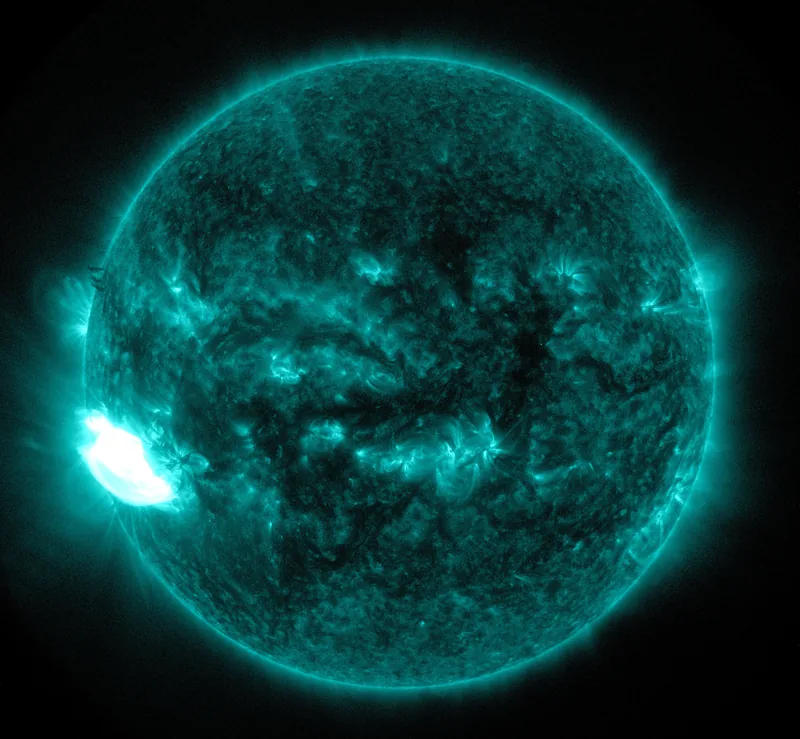
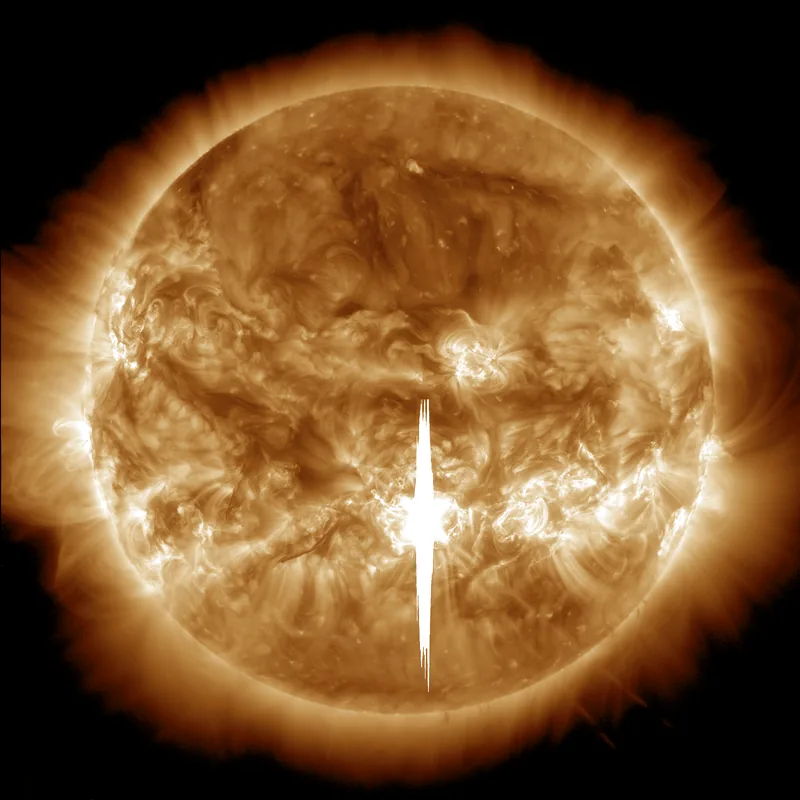
“Solar flares are tremendously energetic bursts of light and particles triggered by the release of magnetic energy on the Sun.” They are “by far the most powerful explosions in the solar system, with energy releases comparable to billions of hydrogen bombs.” [source] The 19 October 2014 still is one X-class flare, captured by the Solar Dynamics Observatory. The 3 October 2024 still is another: NASA’s caption calls it an X9.0 flare, seen in 193 ångström light as a bright flash near the centre.
“Coronal mass ejections, or CMEs, are immense clouds of magnetized particles blasted into space by the Sun at over a million miles per hour, often following after a solar flare.” [source] “When directed at Earth, a CME can produce geomagnetic disturbances that ignite bright auroras, short-circuit satellites, and power grids on Earth, or at their worst, even endanger astronauts in orbit.” [source]
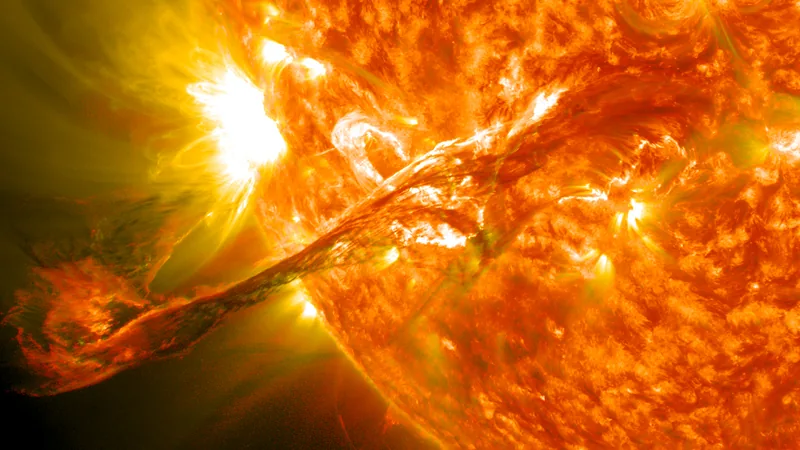
On 31 August 2012, NASA’s caption says, a long filament that had been hovering in the corona erupted at 4:36 p.m. EDT and traveled at over 900 miles per second. It did not travel directly toward Earth, but did connect with the Earth environment later — kept as the file tells it. The pre-eruption prominence from the same day is on the atmosphere page. NASA’s caption on that still says the event “may have been one of the causes of a third radiation belt” later seen by the Van Allen Probes. The “may have been” stays as a maybe.
“The strongest geomagnetic storm on record is the Carrington Event, named for British astronomer Richard Carrington who observed the Sept. 1, 1859, solar flare that triggered the event.” [source] “Telegraph systems worldwide went haywire. Spark discharges shocked telegraph operators and set their telegraph paper on fire.” Just before dawn the next day, “skies all over Earth erupted in red, green, and purple auroras.” They were “so brilliant that newspapers could be read as easily as in daylight,” and “visible as far south as Cuba, the Bahamas, Jamaica, El Salvador, and Hawaii.” [source]
“Another solar flare on March 13, 1989, caused geomagnetic storms that disrupted electric power transmission from the Hydro Québec generating station in Canada, plunging 6 million people into darkness for 9 hours. The 1989 flare also caused power surges that melted power transformers in New Jersey.” [source] “In December 2005, X-rays from a solar storm disrupted satellite-to-ground communications and Global Positioning System (GPS) navigation signals for about 10 minutes.” [source]
The official present tense is quieter, and more practical. “Much like weather on Earth, conditions in space – known as space weather – are always changing with the Sun’s activity.” [source] “Space weather” can “interfere with satellites, GPS, and radio communications. It also can cripple power grids, and corrode pipelines that carry oil and gas.” [source] “NOAA’s Space Weather Prediction Center monitors active regions on the Sun and issues watches, warnings, and alerts for hazardous space weather events.” [source] This site is not that centre, and it does not issue watches.
The cycle underneath all of this has two official lengths. The fact sheet’s sun-spot cycle is 11.4 years. [source] NASA Science says that “approximately every 11 years, the Sun’s geographic poles change their magnetic polarity.” [source] “The latest solar cycle – Solar Cycle 25 – started in December 2019 when solar minimum occurred, according to the Solar Cycle 25 Prediction Panel, an international group of experts co-sponsored by NASA and NOAA. Scientists now expect the Sun’s activity to ramp up toward the next predicted maximum in July 2025.” [source] That last sentence is quoted as the official page stood on 18 November 2026, when the page itself was dated 17 September 2026. This desk does not update it into a later forecast.
Enjoyed this desk of 109.2 Earths, a photosphere that is not solid, and a corona that gets hotter as it leaves?
No pop-ups. No intrusive advertising. Just interesting stuff. A little support helps the next planets.im site get built.