A spinning star
A day that depends on latitude
The Sun is not solid, so it does not have one length of day. NASA Science gives two official figures. The fact sheet gives a third, and a formula that changes with latitude.
“Measuring a ‘day’ on the Sun is complicated,” NASA Science says. “The Sun is made of super-hot, electrically charged gas called plasma. This plasma rotates at different speeds on different parts of the Sun.” [source] “At its equator, the Sun completes one rotation in 25 Earth days. At its poles, the Sun rotates once on its axis every 36 Earth days.” [source] Those are also the official Quick Facts numbers for “Length of day.”
The fact sheet’s official figure is 609.12 hours, adopted at 16 degrees latitude, a Sun/Earth ratio of 25.449 against Earth’s sidereal day of 23.9345 hours. [source] A note on the same table says the actual rotation rate varies with latitude L as (14.37 − 2.33 sin² L − 1.56 sin⁴ L) degrees per day. [source] The two official pages are not arguing. They are measuring a fluid star in different official ways, and this desk keeps each wording on its own line.
The tilt is easier. The fact sheet’s obliquity to the ecliptic is 7.25 degrees. [source] NASA Science says the spin “has a tilt of 7.25 degrees with respect to the plane of the planets’ orbits.” [source] That official number agrees.
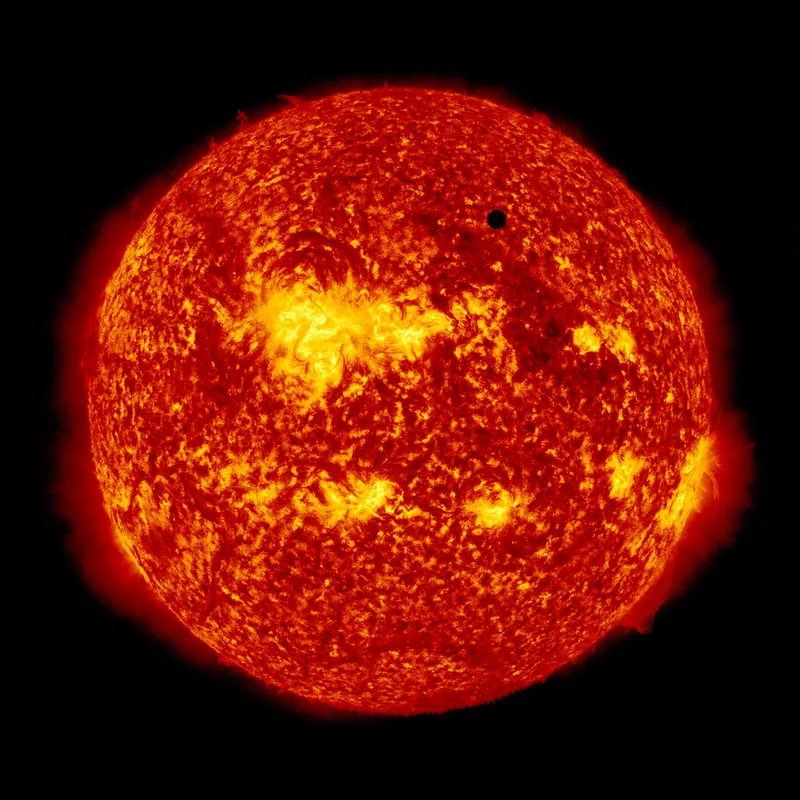
The 5–6 June 2012 still is not about the day length. It is Venus, a small black disk, crossing the face of the Sun in the 304 ångström channel. The file calls the transit “one of the rarest predictable solar events,” happening in pairs eight years apart that are separated from each other by 105 or 121 years, with the previous transit in 2004. It is extreme ultraviolet, with colour added, and it is a reminder that the planets really do go around this star — eight of them, NASA Science says, and “at least five dwarf planets.” [source]
The Sun has a longer official journey too. “The Sun is located in the Milky Way galaxy in a spiral arm called the Orion Spur.” [source] “Our solar system is moving with an average velocity of 450,000 miles per hour (720,000 kilometers per hour). But even at this speed, it takes about 230 million years for the Sun to make one complete trip around the Milky Way.” [source] The fact sheet’s speed relative to nearby stars is a different official figure: 19.4 km/s. [source] For the wider neighbourhood, see milky-way.galaxies.im.
Enjoyed this desk of 109.2 Earths, a photosphere that is not solid, and a corona that gets hotter as it leaves?
No pop-ups. No intrusive advertising. Just interesting stuff. A little support helps the next planets.im site get built.