The desk
How many Earths?
Three official comparisons from the NASA / NSSDCA Sun Fact Sheet, each with NASA Science’s rounded wording sitting beside it, not on top of it.
How many Earths?
A safety note, not an observing guide. NASA Science says, “Hopefully, it goes without saying — but never look directly at the Sun without protecting your eyes.” This site does not tell you how to look at the Sun, and it is not a guide to filters or eclipses.
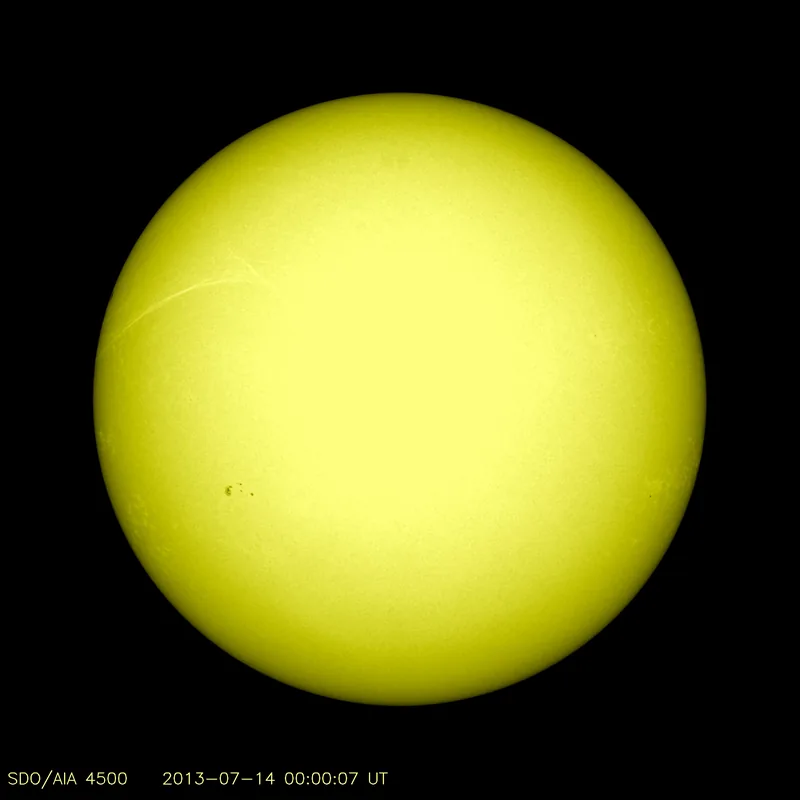
The fact sheet gives the Sun’s volumetric mean radius as 695,700 km and Earth’s as 6,371 km. Divide one by the other and the official ratio is 109.2. [source] About 109 Earths would fit along the Sun’s diameter, if you could line them up. NASA Science’s short list says the Sun is “about 100 times wider than Earth and about 10 times wider than Jupiter, the biggest planet.” [source] This desk draws the speck at 109.2, and leaves the rounded wording in the same paragraph.
Volume is stranger still. The fact sheet’s volume ratio is 1,304,000. [source] NASA Science says “it would take 1.3 million Earths to fill the Sun’s volume.” [source] Mass comes out smaller than that, because the Sun is less dense than the Earth: the fact sheet’s mass ratio is 332,900, and its mean-density ratio is 0.255. [source] NASA Science’s public wording is “more than 330,000 Earths to match the mass of the Sun.” [source]
Other official size sentences live on the same pages and are not forced into those three buttons. NASA Science gives a diameter of “about 865,000 miles (1.4 million kilometers)” and a radius of “about 435,000 miles (700,000 kilometers).” [source] Twice the fact sheet’s 695,700 km is 1,391,400 km, which is the sort of number 1.4 million kilometres is rounding. The field notes keep those official figures on their own lines.
Enjoyed this desk of 109.2 Earths, a photosphere that is not solid, and a corona that gets hotter as it leaves?
No pop-ups. No intrusive advertising. Just interesting stuff. A little support helps the next planets.im site get built.