The photosphere
The surface that is not solid
The part we call the surface is the photosphere: a light sphere, the first layer of the solar atmosphere, and not a ground you could stand on.
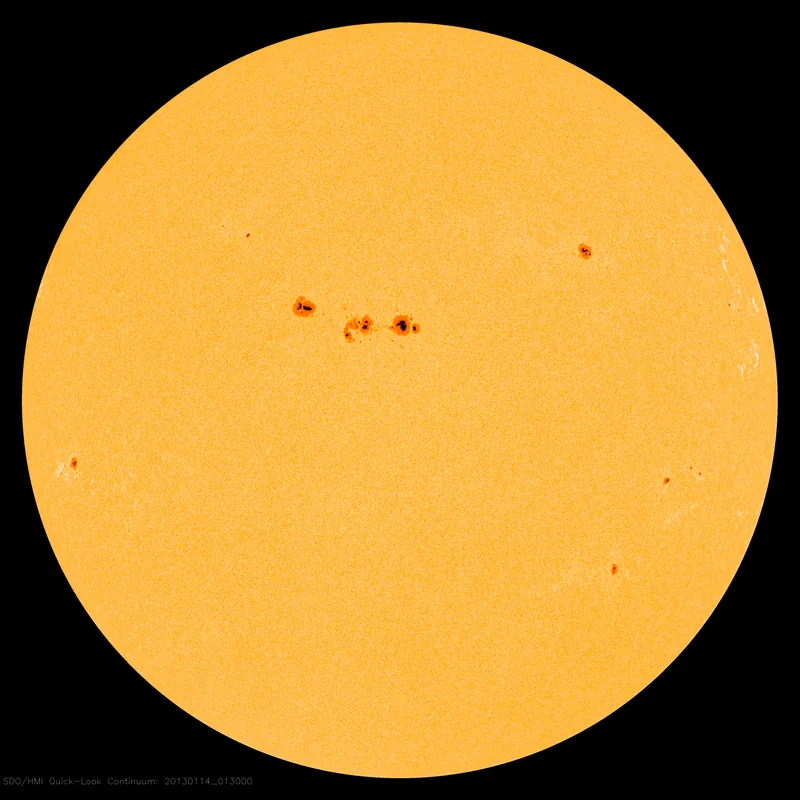
“The part of the Sun we see from Earth – the part we call the surface – is the photosphere,” NASA Science says. “The Sun doesn’t actually have a solid surface because it’s a ball of plasma.” [source] “Although we call it the surface, the photosphere is actually the first layer of the solar atmosphere.” The word itself “means ‘light sphere’ – which is apt because this is the layer that emits the most visible light. It’s what we see from Earth with our eyes.” [source]
A safety note, not an observing guide. NASA Science says, “Hopefully, it goes without saying — but never look directly at the Sun without protecting your eyes.” This site does not tell you how to look at the Sun, and it is not a guide to filters or eclipses.
Relatively cool, on this star, is still astonishingly hot. NASA Science puts the photosphere at “about 10,000 °F (5,500 °C)” and “about 250 miles thick.” [source] “That’s much cooler than the blazing core, but it’s still hot enough to make carbon – like diamonds and graphite – not just melt, but boil.” [source] The fact sheet gives a slightly different official toolkit: an effective temperature of 5,772 K, 4,400 K at the top of the photosphere and 6,600 K at the bottom, and a thickness of about 500 km. [source] Those official figures are kept beside one another on the field notes.
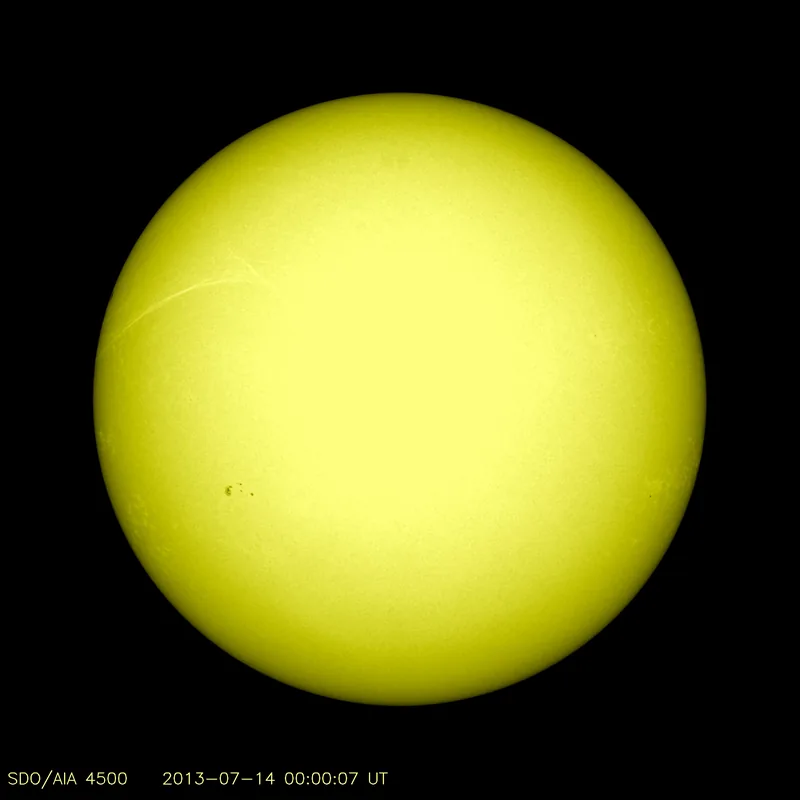
The 14 July 2013 still is a white-light continuum photograph — the file’s own wording — of that photosphere, appearing in bright yellow. The 14 January 2013 HMI still is also white light, and it happens to catch a large cluster of sunspots, Active Region 11654. Sunspots, NASA Science says, “look like dark holes in the Sun, but they are actually areas that are slightly cooler than the surrounding photosphere.” They form “where bits of the Sun’s magnetic field poke out from the interior,” last “from days to months,” and “range in size from 1,000 to 100,000 miles (1,600 to 160,900 kilometers).” [source] The fact sheet gives typical sunspot fields of 3,000 gauss, against a polar field of only 1–2 gauss. [source]
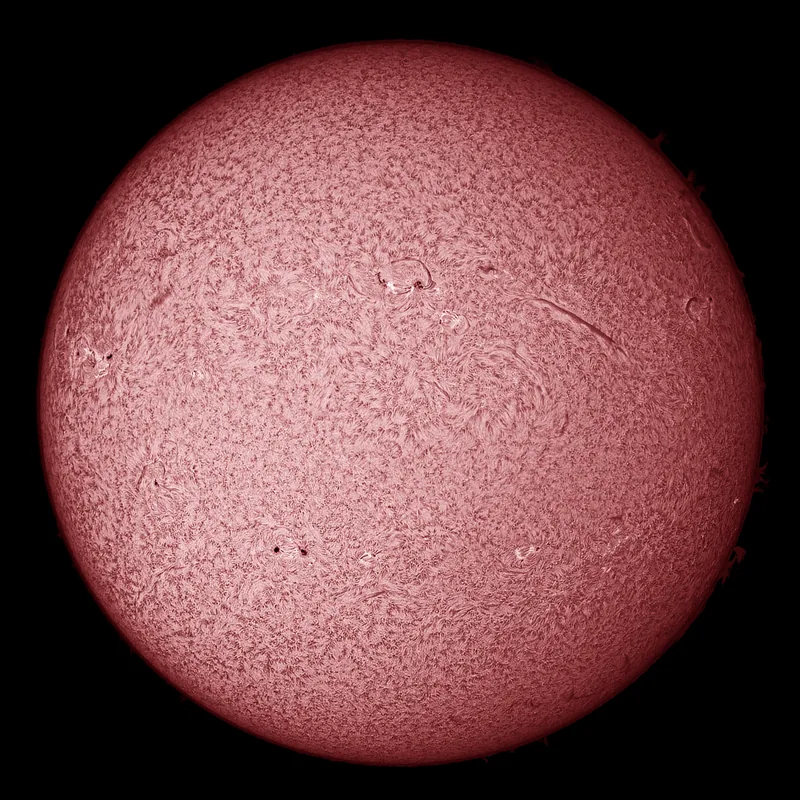
Matúš Motlo’s hydrogen-alpha photograph is a different layer: the chromosphere, coloured, the photographer writes, “to be true to the color one would see when looking through such a telescope.” NASA Science places the thin chromosphere above the photosphere, under the huge corona. [source] The fact sheet gives that chromosphere a thickness of about 2,500 km and a temperature at the top of about 30,000 K. [source] It is not the everyday yellow disk, and it is not a reason to look at the Sun through any telescope without a proper filter.
Enjoyed this desk of 109.2 Earths, a photosphere that is not solid, and a corona that gets hotter as it leaves?
No pop-ups. No intrusive advertising. Just interesting stuff. A little support helps the next planets.im site get built.