Chromosphere and corona
The atmosphere that gets hotter as it leaves
Walk away from a bonfire and you expect to cool down. The Sun’s outer atmosphere does the opposite, and NASA Science still calls that one of the star’s biggest mysteries.
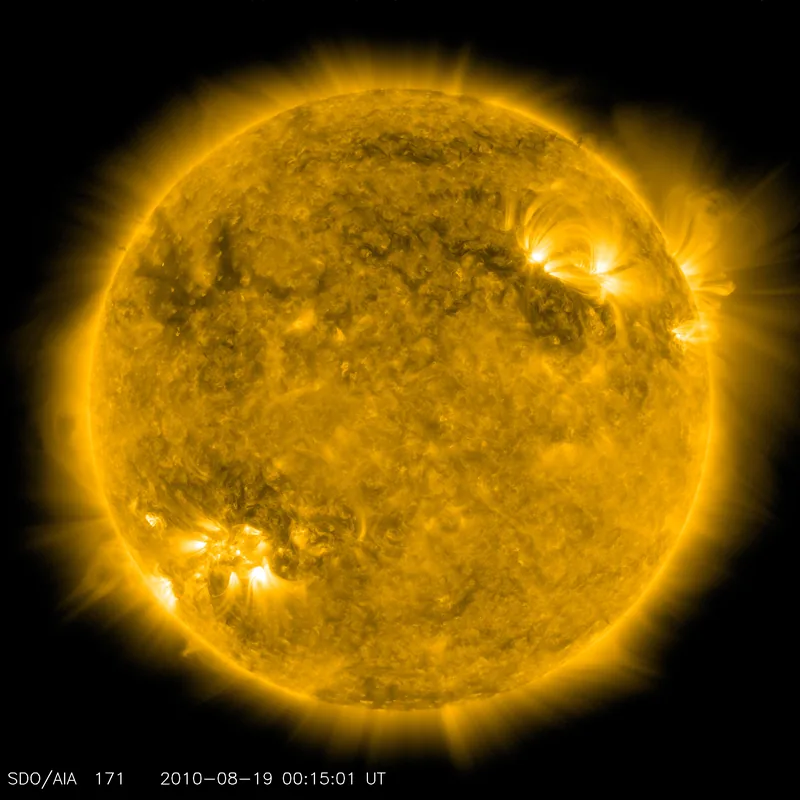
“Above the Sun’s surface are its thin chromosphere and the huge corona (crown).” [source] The photosphere, chromosphere and corona “are all part of the Sun’s atmosphere.” The corona “is sometimes casually referred to as ‘the Sun’s atmosphere,’ but it is actually the Sun’s upper atmosphere.” [source] “Not all scientists refer to the transition zone as its own region – it is simply the thin layer where the chromosphere rapidly heats and becomes the corona.” [source]
“In one of the Sun’s biggest mysteries, the Sun’s outer atmosphere, the corona, gets hotter the farther it stretches from the surface. The corona reaches up to 3.5 million °F (2 million °C) – much, much hotter than the photosphere.” [source] Later the same official page tries a picture: “Imagine walking away from a bonfire only to get warmer.” “The source of coronal heating is a major unsolved puzzle in the study of the Sun.” [source]
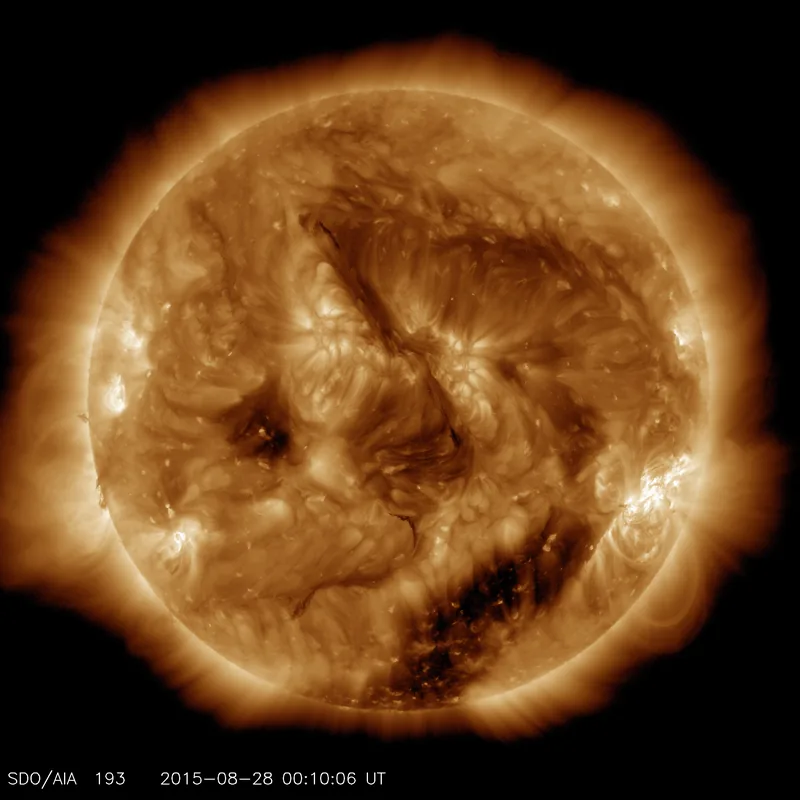
The gold and brown full-disk pictures on this page are not what the eye would see. They are extreme-ultraviolet views from the Solar Dynamics Observatory, with colour added so the loops and dark patches show up. AIA 171, on 19 August 2010, looks at the quiet corona and upper transition region. AIA 193, on 28 August 2015, “highlights the outer atmosphere of the Sun – called the corona – as well as hot flare plasma.” Dark areas in that channel are coronal holes.
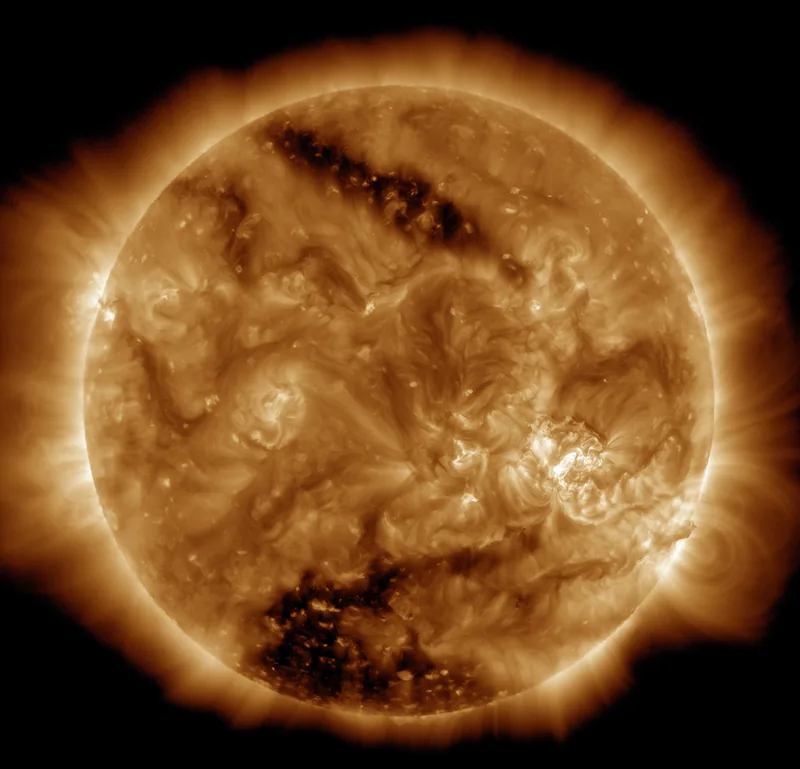
“A coronal hole is a patch of the Sun’s atmosphere with much lower density than the surrounding areas. In ultraviolet views of the Sun, coronal holes appear as dark splotches.” [source] These are regions “where the Sun’s magnetic field lines are connected directly to interplanetary space, allowing solar material to escape out in a high-speed stream of solar wind.” [source] On 16 March 2015, NASA’s caption says, the larger of two holes near the southern pole covered an estimated 6- to 8-percent of the total solar surface.
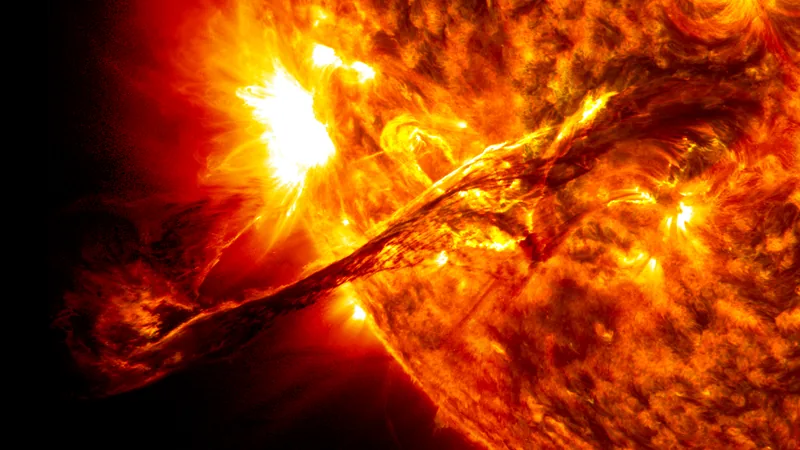
“A prominence is a snakelike structure made of cooler, denser solar material that is suspended above the Sun’s surface by a strong local magnetic field.” Seen against the disk, head-on, the same structures “are called filaments.” [source] They “can erupt when the magnetic structure becomes unstable, flinging their plasma outward in a blast called a coronal mass ejection.” [source] The 31 August 2012 still shows one such prominence before it erupted. The space-weather page picks up the same day from the other side of the blast.
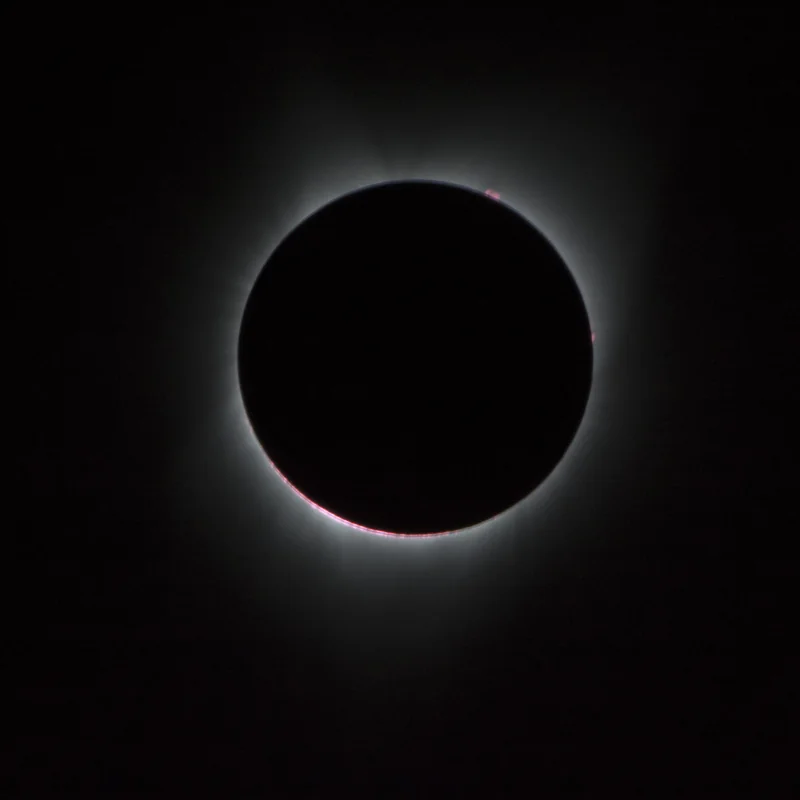
Ordinary white light usually loses this argument. “Visible light from these top regions of the Sun is usually too weak to be seen against the brighter photosphere, but during total solar eclipses, when the Moon covers the photosphere, the chromosphere looks like a fine, red rim around the Sun, while the corona forms a beautiful white crown.” [source] Carla Thomas’s photograph, from a NASA aircraft off the Oregon coast on 21 August 2017, is that white crown. NASA’s caption calls the red spots Baily’s beads, and spells the name Bailey’s. Both wordings stay as written.
Enjoyed this desk of 109.2 Earths, a photosphere that is not solid, and a corona that gets hotter as it leaves?
No pop-ups. No intrusive advertising. Just interesting stuff. A little support helps the next planets.im site get built.