A yellow dwarf’s story
Two official ages, and a long time still to go
NASA Science calls the Sun a 4.5 billion-year-old yellow dwarf, and says it formed about 4.6 billion years ago. Both official wordings stay on this page. So does the official “possibly” about the Earth, billions of years from now.
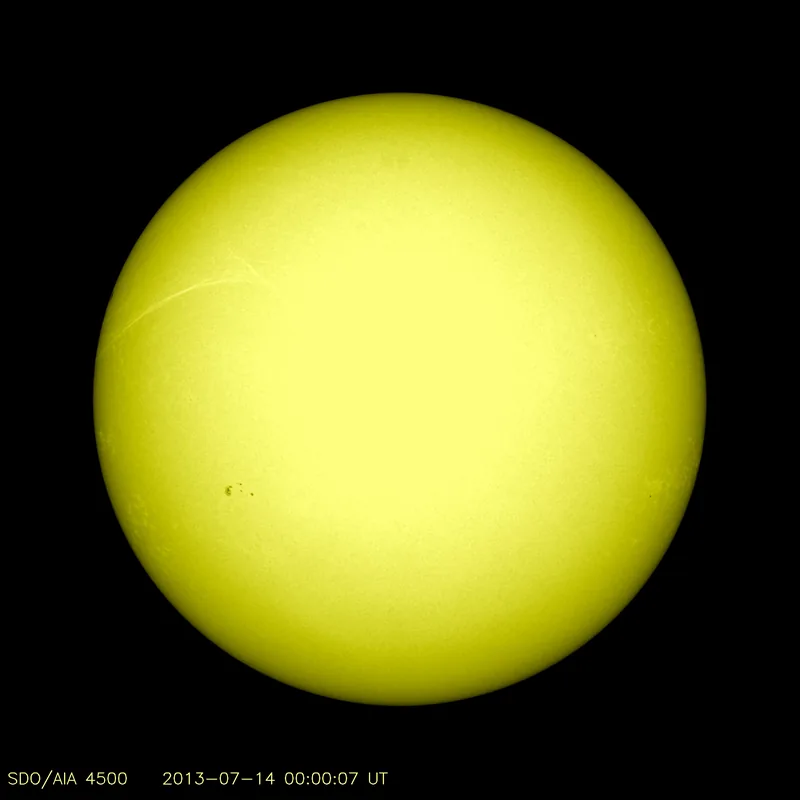
“The Sun formed about 4.6 billion years ago in a giant, spinning cloud of gas and dust called the solar nebula. As the nebula collapsed under its own gravity, it spun faster and flattened into a disk. Most of the nebula’s material was pulled toward the center to form our Sun, which accounts for 99.8% of our solar system’s mass.” [source] The opening sentence on the same official page still calls it “a 4.5 billion-year-old yellow dwarf star.” [source] This desk does not pick one age and quietly drop the other.
A little of that early disk is still in the story. “The Sun would have been surrounded by a disk of gas and dust early in its history when the solar system was first forming, about 4.6 billion years ago. Some of that dust is still around today, in several dust rings that circle the Sun. They trace the orbits of planets, whose gravity tugs dust into place around the Sun.” [source]
The name is older than the tables. “The Latin word for Sun is ‘sol,’ which is the main adjective for all things Sun-related: solar. Helios, the Sun god in ancient Greek mythology, lends his name to many Sun-related terms as well, such as heliosphere and helioseismology.” [source] The science of the Sun’s influence throughout the solar system is called heliophysics. [source]
The official future is long, and carefully worded. “Like all stars, our Sun will eventually run out of energy. When it starts to die, the Sun will expand into a red giant star, becoming so large that it will engulf Mercury and Venus, and possibly Earth as well.” [source] The “possibly” is the official word about Earth, and it stays. “Scientists predict the Sun is a little less than halfway through its lifetime and will last another 5 billion years or so before it becomes a white dwarf.” [source]
It is, even so, “only an average star in terms of its size. Stars up to 100 times larger have been found. And many solar systems have more than one star.” [source] “By studying our Sun, scientists can better understand the workings of distant stars.” [source] Its nearest stellar neighbour, on the same official page, is the Alpha Centauri triple star system, with Proxima Centauri at 4.24 light-years and Alpha Centauri A and B at 4.37. [source]
Enjoyed this desk of 109.2 Earths, a photosphere that is not solid, and a corona that gets hotter as it leaves?
No pop-ups. No intrusive advertising. Just interesting stuff. A little support helps the next planets.im site get built.