Credits
Every photograph on this site
Licences were checked on each source page on 18 November 2026. CC BY and CC BY 3.0 stills are used on the website and credited; they are not placed in the typographic PDFs. CC BY-SA stills are used on the website only, and are not placed in the downloadable fact sheets.
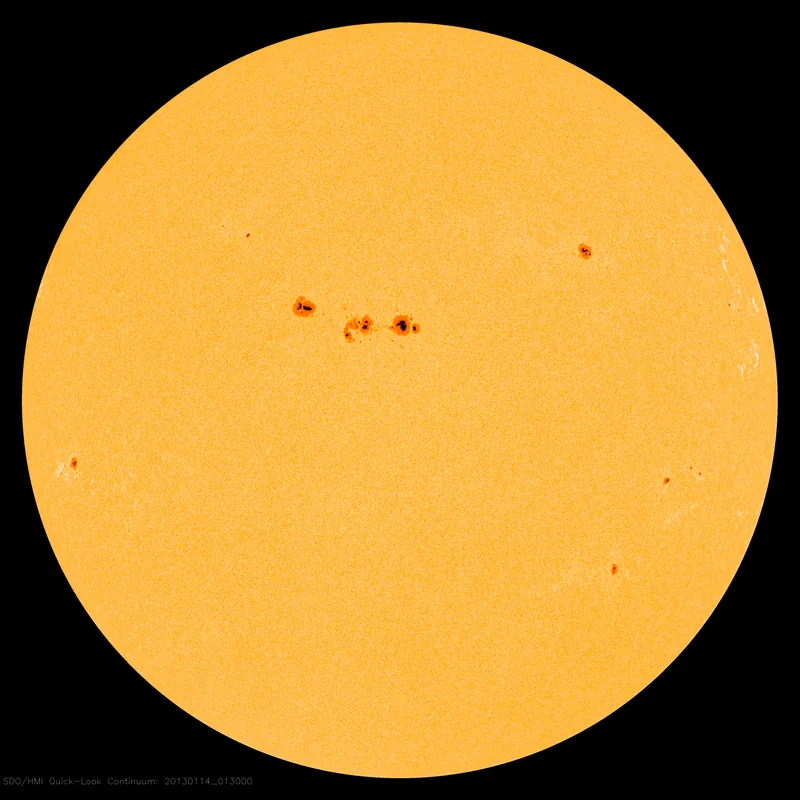
The Sun exhibiting a number of sunspots on 14 January 2013, at 00:13 GMT, photographed by NASA’s Solar Dynamics Observatory (HMI). At the centre sits a large cluster of sunspots, dubbed Active Region 11654, that rotated over the left limb of the Sun on 10 January. This is a white-light view of the photosphere, not a false-colour corona. Released as IAU image iau1508d. CC BY 4.0. Photo: NASA/SDO/HMI · CC BY 4.0 · NASA/SDO/HMI via IAU iau1508d / Wikimedia Commons 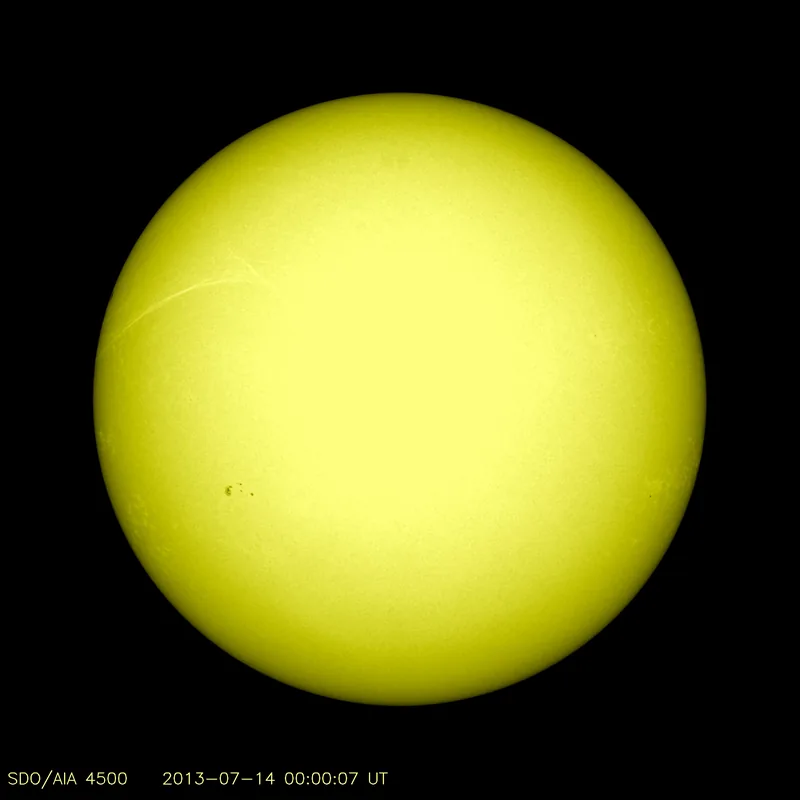
AIA 4500, 14 July 2013, 00:00:07 UT. The file describes this channel as a white-light continuum photograph of the photosphere, in visible light, appearing in bright yellow. Courtesy of NASA/SDO and the AIA, EVE, and HMI science teams. Public domain. Photo: NASA/SDO and the AIA, EVE, and HMI science teams · Public domain · NASA/SDO / Wikimedia Commons 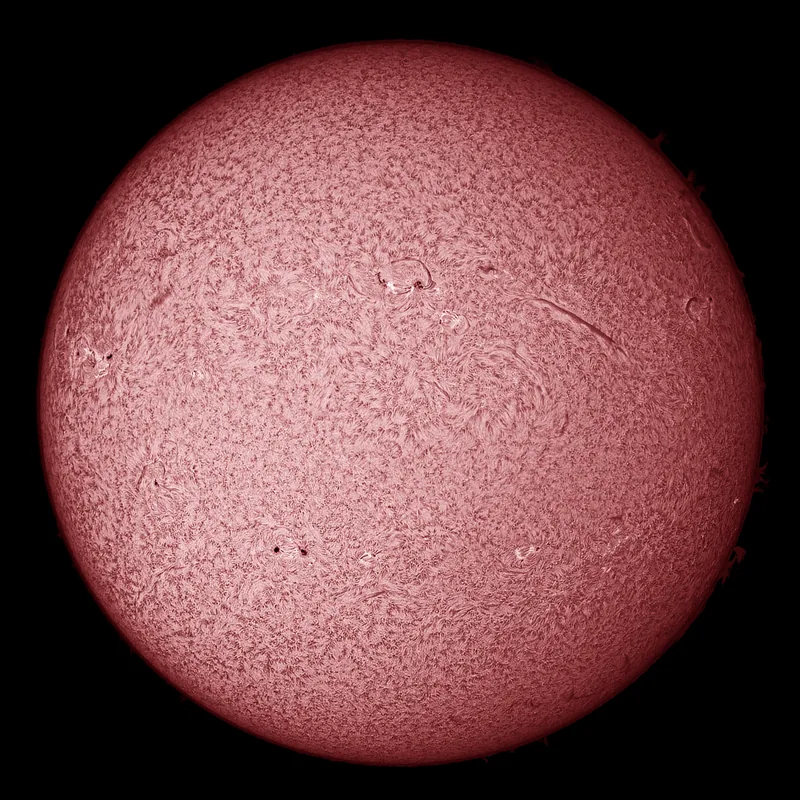
The Sun in H-alpha, photographed by Matúš Motlo on 16 August 2023 with a ZWO camera and a Lunt 80 telescope. The photographer writes that it was “colored afterwards to be true to the color one would see when looking through such a telescope.” This is a chromosphere view, not the everyday yellow disk. CC BY 3.0. Photo: Matúš Motlo · CC BY 3.0 · Matúš Motlo / Wikimedia Commons 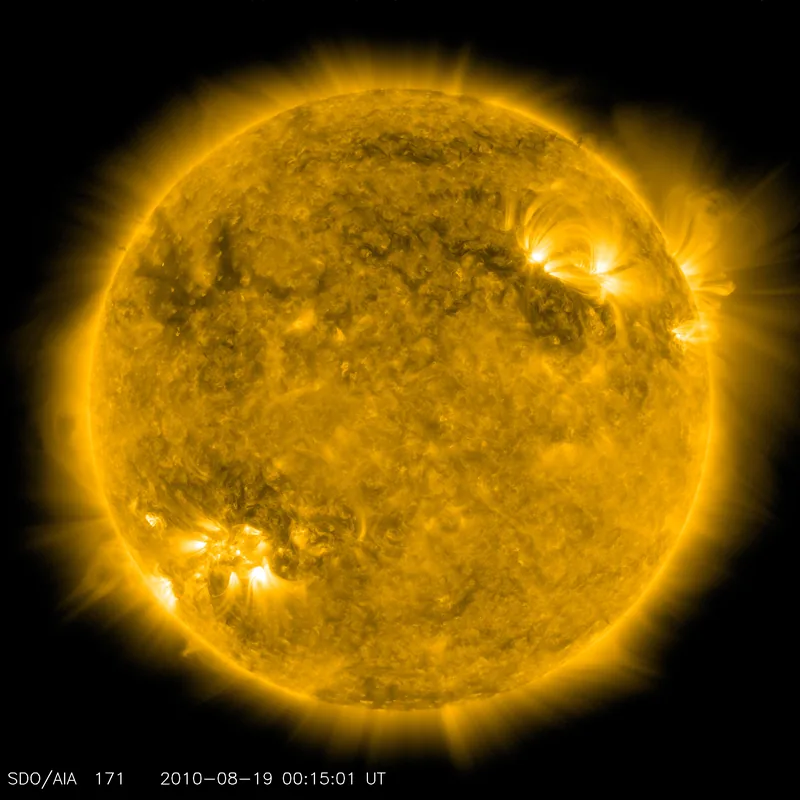
AIA 171, 19 August 2010, 00:15:01 UT. An extreme-ultraviolet view of the quiet corona and upper transition region, with colour added so the loops show up. It is not the yellow disk the eye would see. Courtesy of NASA/SDO and the AIA, EVE, and HMI science teams. Public domain. Photo: NASA/SDO and the AIA, EVE, and HMI science teams · Public domain · NASA/SDO / Wikimedia Commons 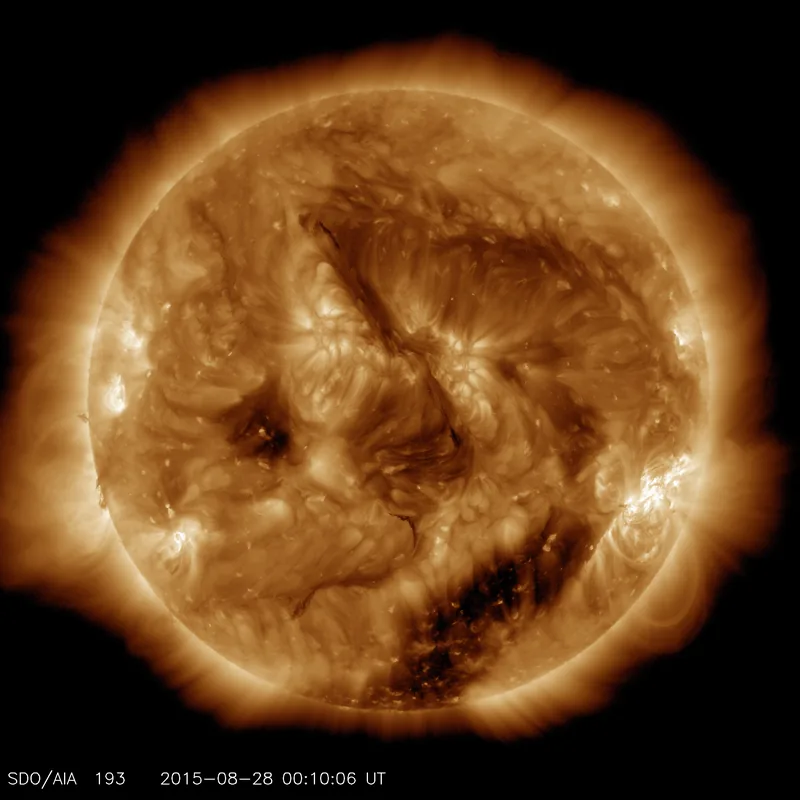
AIA 193, 28 August 2015, 00:10:06 UT. The file says this channel highlights the corona and hot flare plasma; dark areas are coronal holes. Colour is added. Not a visible-light photograph. Courtesy of NASA/SDO and the AIA, EVE, and HMI science teams. Public domain. Photo: NASA/SDO and the AIA, EVE, and HMI science teams · Public domain · NASA/SDO / Wikimedia Commons 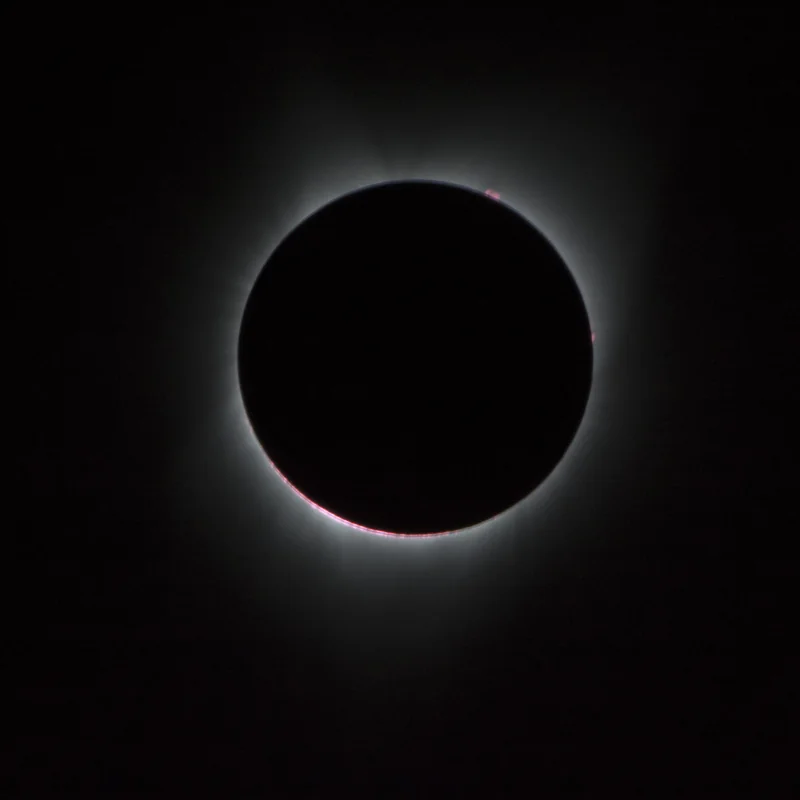
The corona in white light during totality on 21 August 2017, photographed by NASA’s Carla Thomas from a NASA Gulfstream III 25,000 feet above the Oregon coast. Cropped here to the Sun and corona from the wider original frame. NASA’s caption calls the red spots Baily’s beads and spells the name Bailey’s; both wordings are kept. Public domain. Photo: NASA/Carla Thomas · Public domain · NASA/Carla Thomas / Wikimedia Commons 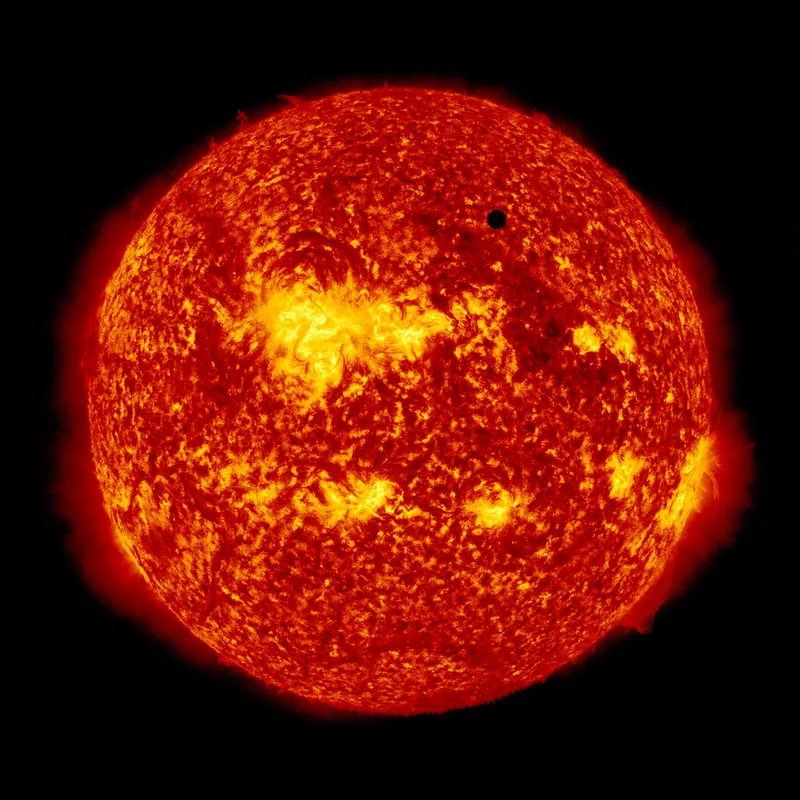
The 5–6 June 2012 transit of Venus, photographed by NASA’s Solar Dynamics Observatory in the 304 ångström channel. The file describes this as “one of the rarest predictable solar events,” happening in pairs eight years apart that are separated from each other by 105 or 121 years, with the previous transit in 2004. Extreme ultraviolet, with colour added; Venus is the small black disk. CC BY 2.0. Photo: NASA/SDO, AIA · CC BY 2.0 · NASA/SDO, AIA / Wikimedia Commons 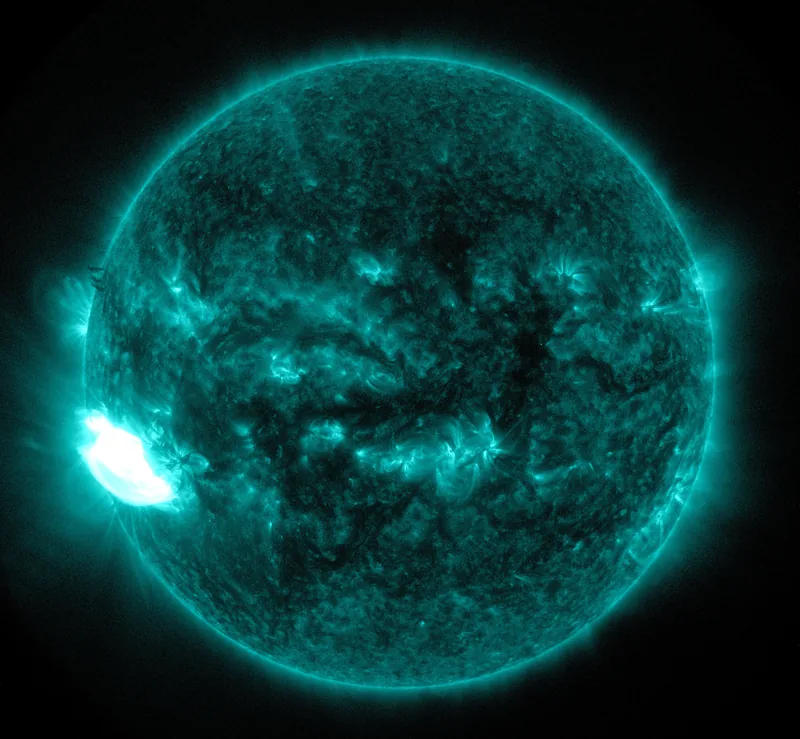
An X-class solar flare peaking at 1:01 a.m. EDT on 19 October 2014, captured by NASA’s Solar Dynamics Observatory. NASA’s caption calls solar flares powerful bursts of radiation. This is an extreme-ultraviolet still, not a visible-light photograph. Public domain. Photo: NASA Goddard Space Flight Center · Public domain · NASA Goddard Space Flight Center / Wikimedia Commons 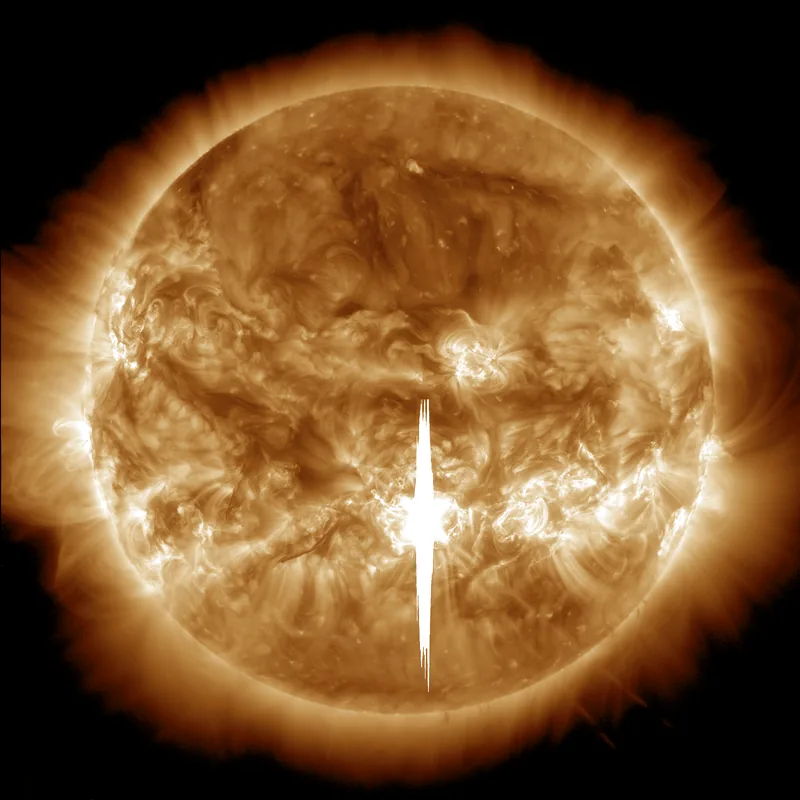
NASA’s Solar Dynamics Observatory captured this image of an X9.0 solar flare — as seen in the bright flash in the centre — on 3 October 2024. The image shows 193 ångström extreme-ultraviolet light, with colour added. Credit on the file: NASA/SDO. Public domain. Photo: NASA's Scientific Visualization Studio — eMITS/Scott Wiessinger, ADNET Systems, Inc./Abbey A. Interrante · Public domain · NASA/SDO / Wikimedia Commons 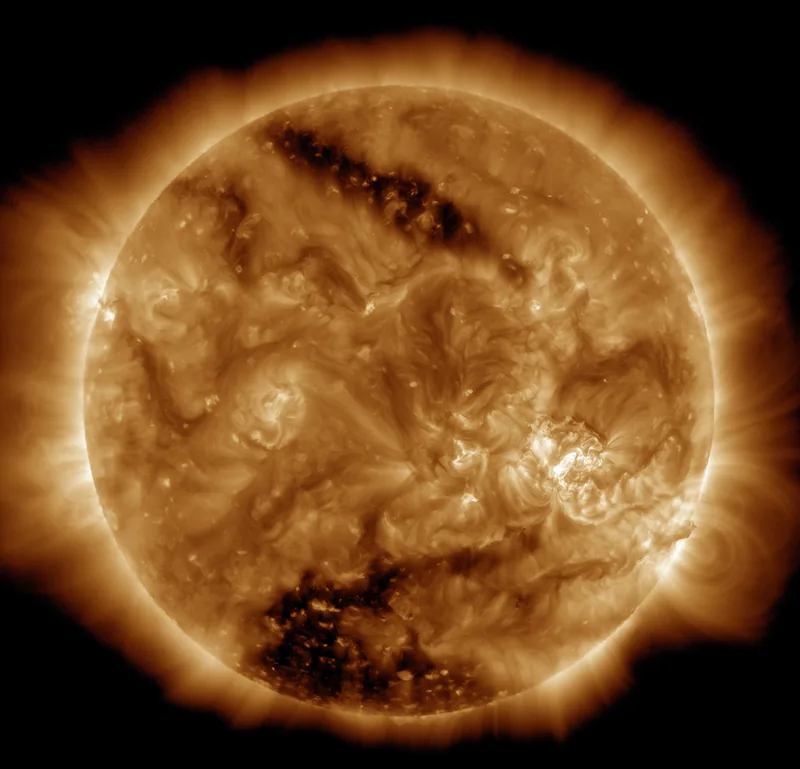
NASA’s Solar Dynamics Observatory captured this solar image on 16 March 2015, which clearly shows two dark patches, known as coronal holes. NASA’s caption says the larger of the two, near the southern pole, covers an estimated 6- to 8-percent of the total solar surface. Extreme ultraviolet, with colour added. Public domain. Photo: NASA Goddard Space Flight Center · Public domain · NASA Goddard Space Flight Center / Wikimedia Commons 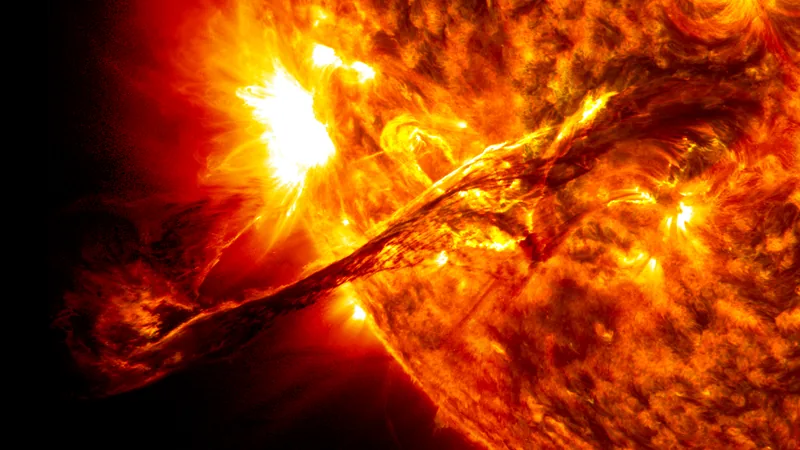
On 31 August 2012, a giant prominence on the Sun erupted. This still, captured by NASA’s Solar Dynamics Observatory, shows the prominence before it erupted. NASA’s caption says the event sent out particles and a shock wave that traveled near Earth, and that it “may have been one of the causes of a third radiation belt” later observed by the Van Allen Probes — official wording kept as a maybe. Public domain. Photo: NASA/SDO/AIA/Goddard Space Flight Center · Public domain · NASA/SDO/AIA / Wikimedia Commons 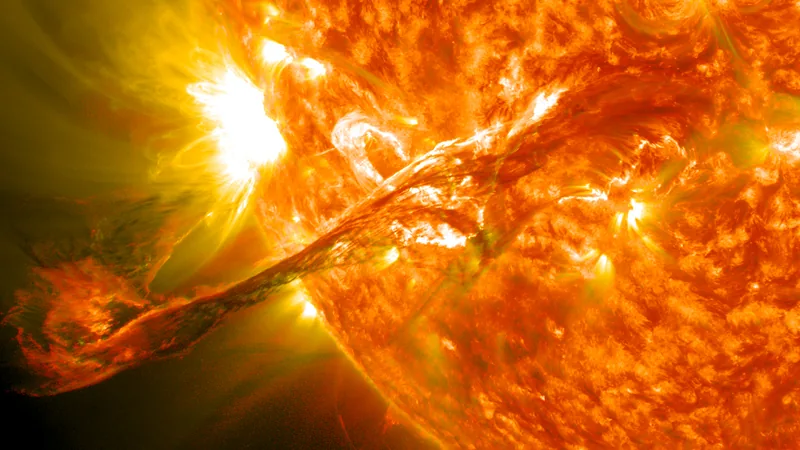
On 31 August 2012 a long filament of solar material that had been hovering in the Sun’s atmosphere, the corona, erupted out into space at 4:36 p.m. EDT. NASA’s caption says the coronal mass ejection traveled at over 900 miles per second. It did not travel directly toward Earth, but did connect with Earth environment later — kept as the file tells it. The same day’s pre-eruption prominence is on this desk too. CC BY 2.0. Photo: NASA Goddard Space Flight Center · CC BY 2.0 · NASA Goddard Space Flight Center / Wikimedia Commons
Enjoyed this desk of 109.2 Earths, a photosphere that is not solid, and a corona that gets hotter as it leaves?
No pop-ups. No intrusive advertising. Just interesting stuff. A little support helps the next planets.im site get built.